
 86 158 01078718
 86 551 65628861
Views: 0 Author: Site Editor Publish Time: 2026-07-08 Origin: Site


The automotive industry is rapidly shifting away from pure metal battery enclosures. This transition relies heavily on advanced composite materials to improve overall vehicle efficiency. Engineers face mounting pressure to balance thermal management requirements and aggressive vehicle light-weighting goals. You must navigate a complex matrix of crash safety standards, strict payload limits, and stringent thermal runaway compliance. Finding a structural material meeting these dynamic demands while remaining scalable for mass production poses a daily challenge.
This guide provides a comprehensive technical evaluation framework for modern composite enclosures. We will deeply explore their structural, thermal, and commercial viabilities. You will learn exactly how advanced fiberglass solutions compare against traditional aluminum extrusions and carbon-fiber alternatives. By understanding these variables, you can confidently optimize your next electric vehicle platform.
Thermal Protection: Fiberglass composites with fire-retardant resins meet strict 5-minute thermal runaway regulations without the need for heavy, secondary insulation layers.
Weight vs. Cost Optimization: Replaces heavier metals, yielding potential weight savings of up to 40%, which translates directly into energy efficiency gains that offset higher material costs.
Corrosion & Conductivity: Unlike carbon fiber or metals, fiberglass is naturally non-conductive, eliminating internal short-circuit risks and preventing galvanic corrosion when joined with lower metal trays.
Scalability: Modern molding techniques (SMC and HP-RTM) allow cycle times suitable for mass production, paired with structural adhesives to simplify final assembly.
Engineers have long relied on aluminum extrusions for battery enclosures. This baseline metal argument makes logical sense for early vehicle architectures. Aluminum excels in structural crash management. It effectively absorbs kinetic energy during side-impact collisions. Manufacturers can also integrate liquid cooling channels directly into hollow extruded profiles. However, these metal systems remain inherently heavy. They also conduct heat rapidly across the entire battery pack.
Modern vehicle designs expose the limitations of pure metal construction. An FRP Battery Box Cover offers a compelling alternative. Fiberglass composites feature a thermal conductivity approximately 200 times lower than aluminum. This massive difference alters how engineers approach pack safety. You no longer need to rely entirely on secondary cooling mechanisms to isolate a localized cell failure.
The primary decision criterion often comes down to prioritizing safety and range. If heat isolation and weight reduction represent your primary success criteria, composites win. A well-designed fiberglass structure outperforms aluminum without sacrificing the required torsional rigidity. You can delay fire propagation to the passenger cabin much more effectively.
Performance Metric | Aluminum Extrusion | Fiberglass Composite (FRP) |
|---|---|---|
Thermal Conductivity | Extremely High (~205 W/m·K) | Extremely Low (~0.3 W/m·K) |
Electrical Conductivity | High (Requires isolation) | Zero (Naturally non-conductive) |
Weight Potential | Baseline (Heavy) | Up to 40% Lighter |
Corrosion Resistance | Susceptible to galvanic corrosion | Immune to rust and galvanic action |
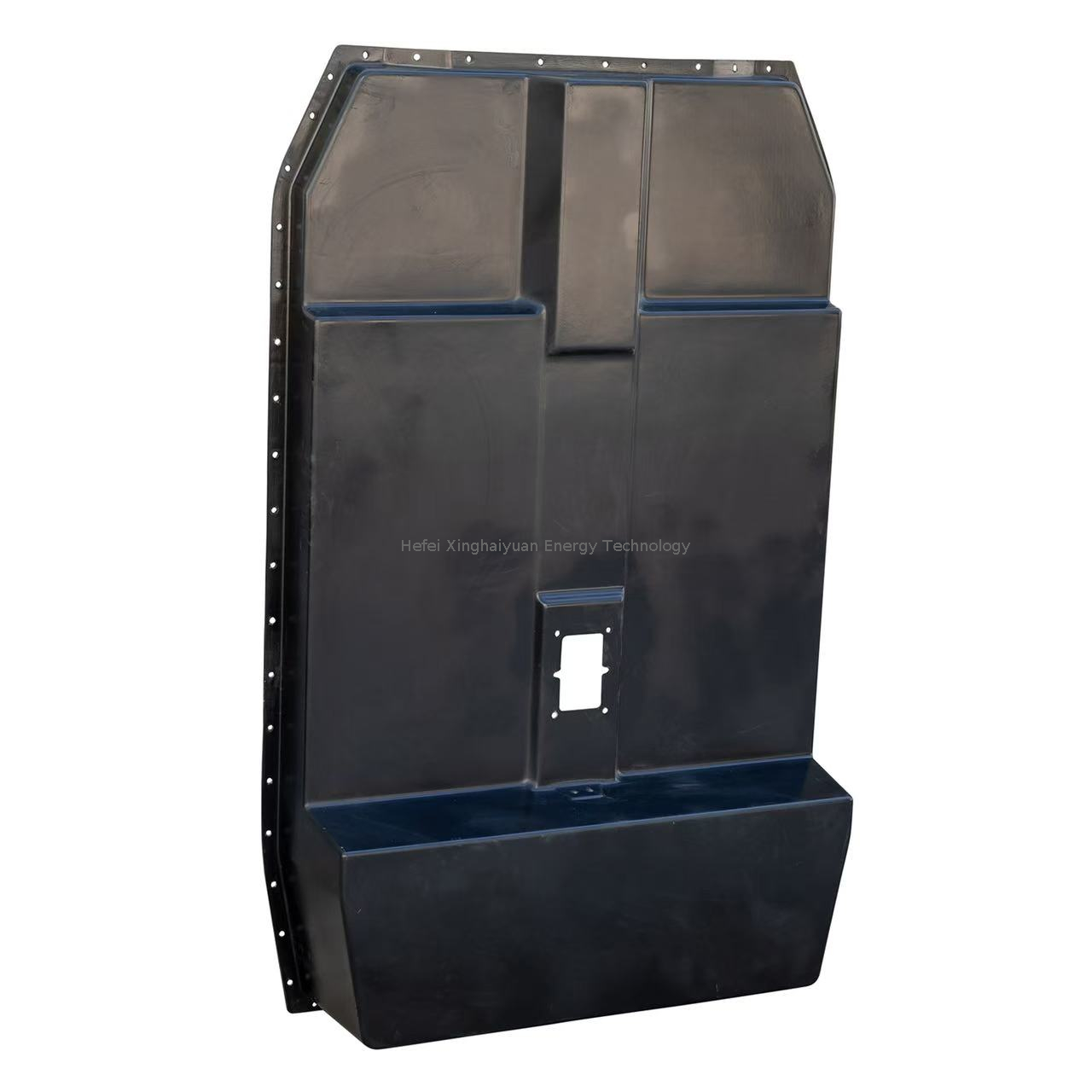
Regulatory bodies continue to tighten safety standards for electric vehicles. Modern compliance demands strict thermal runaway protocols. Passengers require at least a 5-minute escape window before a battery fire penetrates the enclosure. This threshold forces a fundamental rethink of top-cover materials.
Material performance data starkly highlights the risks of traditional metals. A standard aluminum sheet typically burns through in roughly 2.5 minutes when exposed to 1100ºC. This rapid failure falls well short of modern safety mandates. In contrast, a properly specified Fiberglass EV Battery Box Cover utilizes advanced fire-retardant resins. These specialized composites consistently sustain 5 or more minutes of direct 1100ºC exposure without penetration.
Using fiberglass significantly simplifies the overall pack design. The extremely low heat-transfer rate often eliminates the need for additional mica or ceramic insulation sheets. You reduce the total part count. You streamline the assembly process. Less complexity means fewer potential points of failure during the manufacturing phase.
Evaluating the polymer matrix is just as critical as choosing the reinforcing fibers. The resin binds the glass fibers together. It dictates the final durability, chemical resistance, and crash performance of the cover. Engineers typically choose between epoxy and vinyl-ester (VE) systems.
Vinyl-ester prepregs often offer superior comprehensive performance over traditional epoxy formulations. Performance metrics clearly favor VE in demanding automotive environments. They deliver higher tensile strength, often reaching around 468 MPa. They also provide exceptional flexural strength under dynamic loads. This strength is vital for maintaining structural integrity as the vehicle chassis flexes over rough terrain.
Aging and impact resistance further differentiate these two matrices. Vinyl-ester composites exhibit noticeably lower damp-heat aging degradation. Tests show VE degrades by roughly 17% under severe moisture and heat, compared to a 25% degradation rate for standard epoxy. Furthermore, VE materials boast higher impact toughness. This characteristic makes them ideal for bottom-facing components or highly exposed Fiberglass Automotive Parts. They resist chipping and micro-fracturing when struck by road debris.
Combining a fiberglass cover with an aluminum or steel lower tray introduces distinct engineering challenges. Joining heterogeneous materials requires careful assembly protocols. You must prevent fluid leakage while avoiding stress fractures caused by differing coefficients of thermal expansion.
Engineers solve this using advanced adhesive solutions. Applying polyurethane structural adhesives alongside mechanical fasteners ensures a highly robust, watertight seal. This method easily achieves IP69 leak tightness. Crucially, the adhesive layer completely prevents galvanic corrosion. It acts as an isolation barrier between dissimilar materials.
Moisture control represents another critical innovation area. Passive climate management inside the sealed box is rapidly evolving. The industry is shifting away from maintenance-heavy silica gel packs. Instead, engineers now integrate Superabsorbent Polymer (SAP) coated non-wovens.
Here is why SAP materials are becoming the industry standard:
Dynamic Absorption: They actively absorb condensation generated by active cooling micro-leaks.
High Expansion Rate: SAP sheets can expand from 2mm up to 10mm when fully saturated, locking moisture away from sensitive busbars.
Zero Maintenance: Unlike silica gel, SAP materials do not suffer from severe moisture hysteresis and never require bi-annual replacement.
Weight Efficiency: They add negligible mass to the final battery pack while providing superior environmental protection.
Proving a material works in a laboratory is only the first step. You must also evaluate production processes based on high-volume feasibility. Modern composite manufacturing can easily meet automotive cycle time requirements if engineers select the correct methodology.
Sheet Molding Compound (SMC) provides an excellent entry point for mass production. It significantly reduces initial capital expenditure. Tooling costs for SMC molds typically run 25% to 75% lower than comparable metal stamping dies. For areas requiring extreme structural strength, High-Pressure Resin Transfer Molding (HP-RTM) offers a robust solution. HP-RTM technology can reduce cycle times to mere minutes, making it viable for high-stress zones.
The commercial benefit chain of composite adoption is highly persuasive. Reducing the total enclosure weight by 100 kg can improve driving energy efficiency by roughly 4%. This efficiency gain gives OEMs a strategic choice. They can either extend the vehicle's advertised range or specify slightly smaller battery capacities. Using a lighter Fiberglass Battery Box directly offsets the higher initial procurement cost of advanced composite materials.
Every structural material presents specific challenges. Designing a successful composite enclosure requires acknowledging and mitigating several known limitations.
The recycling challenge remains a significant hurdle. Complex adhesive assemblies make end-of-life material separation difficult. Traditional mechanical shredding ruins the continuous glass fibers. Future-proofing your design requires evaluating emerging "de-bonding on demand" technologies. These innovative systems separate materials via localized thermal, chemical, or electrical triggers during the dismantling phase.
Ballistic impact vulnerabilities also require careful consideration. While an FRP cover handles top and side loads effectively, the lowest vehicle skid plates face extreme hazards. High-speed, small-object road debris can cause localized puncture damage. Engineers often integrate localized metal reinforcements or specialized aramid fiber patches at the lowest strike points to prevent fracture.
Safety in prototyping is another crucial factor for low-volume or custom builds. To minimize risks, follow these strict handling protocols:
Dust Control: Always use localized extraction systems and proper respiratory gear to prevent fiberglass dust inhalation during trimming operations.
Vacuum Integration: Implement strict vacuum-bagging protocols. This optimizes the strength-to-weight ratio by pulling out excess resin.
Ventilation: Ensure proper ventilation to eliminate toxic off-gassing from curing resins.
Curing Cycles: Strictly monitor post-cure temperatures to prevent warping before the resin fully cross-links.
Specifying a fiberglass EV battery cover fundamentally shifts the design bottleneck. You move away from constantly managing excess weight and heat transfer. Instead, your focus shifts to optimizing composite manufacturing processes and assembly techniques. This transition ultimately yields a safer, more efficient electric vehicle.
Your shortlisting logic should remain objective. Prioritize fiberglass over aluminum if thermal runaway delays and weight-to-range ratios are critical to your platform. Prioritize fiberglass over carbon fiber if budget constraints and electrical insulation are paramount. Fiberglass inherently avoids the severe short-circuit risks associated with conductive carbon materials.
Your next step is practical validation. Engage directly with Tier 1 composite suppliers. Request sample plaques specifically designed for localized UL94 V-0 flame testing. You should also initiate structural adhesive compatibility trials with your chosen lower tray materials to ensure long-term IP69 reliability.
A: Yes, utilizing continuous glass-fiber reinforced composites can reduce component weight by 30% to 40% compared to traditional aluminum, significantly lowering the overall vehicle mass.
A: Since fiberglass enclosures are typically tightly sealed using structural adhesives, engineers often integrate Superabsorbent Polymer (SAP) materials inside the box. SAPs manage moisture dynamically and outperform traditional silica gel by eliminating the need for periodic replacement.
A: Yes, but it introduces distinct risks. Carbon fiber is highly conductive; without flawless internal insulation, it poses a severe short-circuit risk if a cell vents or a busbar shifts. Fiberglass is naturally non-conductive, providing built-in electrical isolation at a significantly lower cost.


 info@xhyfrp.com.cn
 86-15801078718
 Plant No.4, Area E, Nanju Industrial Park,Hangbu Town, Shucheng County, Anhui, China


