
 86 158 01078718
 86 551 65628861
Views: 0 Author: Site Editor Publish Time: 2026-06-02 Origin: Site


Building modern recreational vehicles requires a delicate balance of engineering. You need a robust structure capable of handling heavy payloads. You also need to maximize aerodynamic efficiency on the highway. Modern recreational vehicles and custom truck bodies face conflicting demands today. You must increase payload capacity and integrate heavier internal amenities. However, you also have to strictly manage gross vehicle weight (GVWR). Managing this weight ensures regulatory compliance and improves overall fuel economy.
Transitioning from traditional wood-framed aluminum siding to Fiber-Reinforced Plastic (FRP) offers a reliable solution. FRP delivers superior strength-to-weight ratios for your vehicle builds. It completely eliminates rust issues found in metal alternatives. It also allows for seamless, aerodynamic shapes. This guide evaluates the commercial and operational realities of sourcing fiberglass body components. We cover everything from engineering proper fitment to managing hidden logistics costs in your supply chain.
Lightweighting & Efficiency: Replacing metal panels with FRP significantly reduces chassis load, directly improving fuel economy and towing dynamics.
The Fitment Factor: High-quality OEM/ODM suppliers utilize CAD-to-CNC mold validation to eliminate the extensive cutting and sanding traditionally associated with aftermarket fiberglass.
The automotive and recreational vehicle industries constantly seek materials offering high performance and low weight. Metal panels served the industry for decades. However, they present significant limitations regarding weight, shape flexibility, and corrosion. Transitioning to Fiberglass Motorhome Parts solves many of these historical manufacturing challenges.
Weight directly impacts vehicle performance. A molded fiberglass shell offers a massive advantage here. You can reduce structural weight by hundreds of pounds compared to steel or heavy-gauge aluminum. This significant weight reduction improves acceleration and braking distances. It also dramatically boosts fuel efficiency. Lighter vehicles experience less strain on their engines and transmissions. This extends the lifespan of the entire drivetrain. Fleet operators and individual owners alike highly value these efficiency gains.
Recreational vehicles often operate in harsh outdoor environments. They face coastal salt spray, intense sun, and winter road salt. FRP is naturally corrosion-proof. Unlike steel, it will never rust. Unlike aluminum, it avoids galvanic corrosion issues. You can pair fiberglass components with premium marine-grade gel coats. This combination makes them highly resistant to UV degradation. They maintain their structural integrity and visual appeal for decades.
Best Practice: Always specify UV-resistant gel coats for exterior parts exposed to harsh sunlight. Standard indoor gel coats will chalk and yellow rapidly outdoors.
Collisions and impacts are inevitable realities of driving. Metal panels permanently dent upon impact. They often require complete replacement. Fiberglass behaves differently. It flexes and absorbs shock upon impact. It distributes the force across the panel structure. In the event of a fracture, you can perform localized repairs easily. Technicians use resin and fiberglass cloth to rebuild the damaged area. They can do this rapidly without requiring total panel replacement. This repairability significantly reduces maintenance downtime.
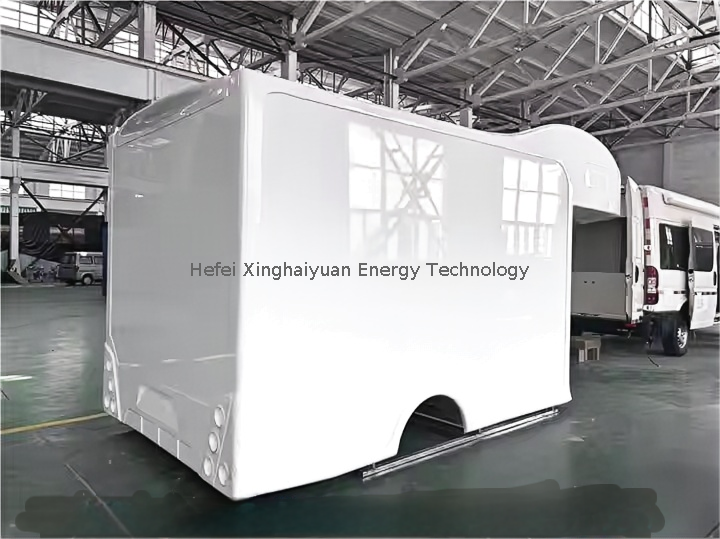
Modern composite manufacturing allows engineers to cast complex shapes in single pieces. This eliminates seams and mechanical fasteners. Sourcing reliable Fiberglass RV Parts requires understanding the different categories of components available.
Exterior Aerodynamics & Enclosures: Air resistance hurts fuel economy. Custom-molded aerodynamic shrouds and side skirts solve this problem. You can install seamless front and rear bumpers to reduce drag. A high-quality Fiberglass RV Panel works perfectly for dry vans, toy haulers, and slide-in campers. These flat panels provide excellent rigidity while maintaining a smooth surface for decals and paint.
Roofing & Weather Sealing: Water leaks destroy recreational vehicles. Traditional metal roofs rely on caulked seams. These seams eventually fail. One-piece fiberglass roof caps eliminate structural seams entirely. You can also integrate a customized Fiberglass RV Roof Vent Cover. These molded additions drastically reduce the risk of water ingress common in traditional RV manufacturing.
Chassis Protection & Storage: The lower sections of a vehicle endure constant abuse. High-durability wheel wells withstand road debris and gravel strikes effectively. You can also utilize fiberglass for external luggage boxes and heavy-duty service hatches. These parts protect expensive batteries and generators from the elements.
Interior Wet Zones: Moisture control matters inside the vehicle too. FRP is ideal for interior wet zones. You can install QAI-compliant shower enclosures and waterproof partition walls. Fiberglass sinks handle high moisture and continuous rugged use effortlessly. They will not warp or rot like wood-based laminates.
The composite industry often struggles with precision. Buyers frequently complain about poorly fitting parts. Understanding how top-tier manufacturers control dimensions is critical for your procurement success.
The most common objection to fiberglass parts is poor assembly tolerance. Bad molds produce warped parts. This forces your fabricators to spend costly labor hours on modifications. They end up cutting, grinding, and forcing parts into place. This slows down assembly lines and ruins production schedules. Precise fitment starts with exceptional mold making.
Reputable suppliers do not guess dimensions. They validate concepts using precise 3D mockups. They often utilize expanding foam for early shaping and design verification. Once approved, they create CNC-machined master plugs. CNC milling ensures exact dimensional accuracy down to the millimeter. This digital-to-physical workflow guarantees production molds match your engineering files perfectly.
Common Mistake: Approving a costly production mold based solely on 2D drawings. Always demand a 3D physical mockup or CNC plug validation first.
Not all fiberglass is equal. You must evaluate whether a project requires standard E-glass or high-tensile S-glass. S-glass offers higher strength but costs more. Decision-makers must also specify the correct resin system based on application requirements.
Table 1: Resin System Specifications | ||
Resin Type | Primary Characteristic | Ideal RV Application |
|---|---|---|
Polyester | Cost-effective, standard strength | Interior panels, standard exterior shrouds |
Vinyl Ester | High corrosion and moisture resistance | Wheel wells, battery boxes, marine environments |
Fire-Retardant Epoxy | Maximum strength and safety compliance | Structural chassis components, engine bays |
Choosing the right production method dictates your part quality and volume limits. You must align the manufacturing process with your business goals.
Hand lay-up involves technicians manually wetting out fiberglass mats. It remains highly cost-effective for small-batch custom runs. It works well for heavy-duty structural parts and rapid prototyping. It offers immense flexibility during design changes. However, it requires highly skilled quality control. Technicians must manually manage resin-to-glass ratios. Too much resin makes the part brittle and heavy. Too little resin leaves dry spots and weakens the structure.
Vacuum infusion uses negative pressure to draw resin through the fiberglass matrix. It is the optimal choice for high-precision, lightweight panels. It guarantees a consistent thickness and maximum strength every time. It eliminates human error regarding resin distribution. This method proves ideal for scaleable, continuous production of large exterior panels.
Chart 1: Comparison of Manufacturing Methods | ||||
Process | Tooling Cost | Production Speed | Part Consistency | Best For |
|---|---|---|---|---|
Hand Lay-up | Low | Moderate | Medium (Skill-dependent) | Prototypes, small batches, thick structural parts |
Vacuum Infusion | High | Fast | Excellent (Highly uniform) | Large flat panels, high-volume production, weight-critical parts |
You cannot compromise on safety. Manufacturers must ensure manufacturing outputs align with regional automotive safety standards. Look for suppliers familiar with AS/NZS or DOT equivalent frameworks. They must provide data specifically regarding load-bearing capacity. They also need to prove structural integrity during transit vibrations. Always request documented pull tests and flexural strength reports for critical body panels.
Buying composite parts involves more than just unit pricing. Logistics and surface preparation can destroy your project budget if ignored.
Raw fiberglass components present unique shipping challenges. They are bulky and surprisingly fragile before installation. They only gain their final rigidity once mounted to a steel or aluminum vehicle frame. Therefore, buyers must account for specialized freight handling. Suppliers usually build custom wooden crates to protect parts during transit. You must explicitly budget for these custom crating costs. The industry commonly refers to these as "box fees." Freight companies often deny damage claims if parts ship without robust wooden crating.
FRP parts rarely arrive ready for topcoat paint. Components typically arrive in a raw gel coat or primer state. This raw finish often shows minor mold release lines or pinholes. Buyers need to allocate internal labor for surface prep. Your team must perform high-strength sanding. They will need to apply body filler to achieve a perfectly flat Class-A surface prior to painting. Do not underestimate the labor hours required for this preparation phase.
Painting composite vehicle bodies requires specific chemical formulations. Vehicle chassis flex constantly during highway transit. This movement transfers directly to the body panels. Because of this, final paint applications on FRP must include flexible additives. If you use standard rigid automotive paint, it will fail. The clear coat or base color will develop spider-cracking over time. Ensure your paint shop understands how to treat composite substrates properly.
Switching to fiberglass body components offers immense advantages for modern vehicle builders. It solves weight problems, eliminates rust, and allows for superior aerodynamic styling. However, success depends entirely on how you manage the procurement and engineering processes.
Shortlisting Logic: Vet suppliers based on their CAD capabilities. Demand documented OEM/ODM experience. Verify their ability to produce consistent dimensional tolerances across multiple production runs.
Next-Step Actions: Request detailed material spec sheets, including resin types and gel coat UV ratings.
Validate Safety: Ask for structural load testing data to ensure compliance with highway safety standards.
Test Before Scaling: Always initiate a small-batch pilot run. Use this pilot to test assembly fitment in your shop before committing to high Minimum Order Quantities (MOQs).
A: No. Unlike aluminum that must be pulled or replaced, FRP cracks can be ground out easily. Technicians structurally rebuild the area using fiberglass mat and resin. You can often perform these repairs without removing the entire panel from the vehicle.
A: FRP panels offer a seamless, rivet-free surface. This improves aerodynamics, completely eliminates rust, and provides superior impact absorption. Aluminum, conversely, is highly prone to permanent denting and frequent seam leaks.
A: Rarely. Most parts ship in a protective gel coat or base primer. They require thorough scuffing and proper surface preparation. You must also use flexible paint additives to ensure long-term finish durability under normal chassis flex.


 info@xhyfrp.com.cn
 86-15801078718
 Plant No.4, Area E, Nanju Industrial Park,Hangbu Town, Shucheng County, Anhui, China


